St. Laurent at a glance Also known as: Saint Laurent and Sankt LaurentOrigin: Austria, mainly the Thermenregion and BurgenlandStyle: light to medium-bodied, with soft, elegant tanninsFlavour: red and black cherry, plum and spice, with cinnamon when oak-agedServing: 16 to 18 degrees Celsius, lighter wines a little coolerPairs with: duck, game, poultry, mushrooms and mild cheeseKeeping: fruity 3 to 5 years, oak-aged often 8 years or moreWhat is St. Laurent? St. Laurent is a red grape that is at home in Austria. Its exact origin is unknown. The first documented planting in Austria dates from 1893, by Klosterneuburg Abbey near Vienna, and in 1972 St. Laurent was recognised as a quality grape variety. Austria has around 600 hectares of it, just over 1% of all vineyards. That makes it smaller and rarer than Zweigelt , even though St. Laurent is one of Zweigelt's parents.
The grape is demanding in the vineyard. It ripens early, is sensitive and does not give the same yield every year. Winemakers therefore carefully choose the best plots. You can see this in our range: many St. Laurent wines come from a single named vineyard, a Ried.
What does St. Laurent taste like? St. Laurent tastes of ripe red and black cherries, sour cherries and plums, often with a spicy note. The tannins are soft and elegant, the acidity fresh. After ageing in oak, notes of cinnamon and spice appear. The style is similar to Pinot Noir, but alongside red fruit you often taste black cherry in St. Laurent.
St. Laurent, Saint Laurent or Sankt Laurent? They are the same grape. Austrian labels usually say St. Laurent, sometimes written in full as Sankt Laurent. The name probably refers to Saint Lawrence, whose feast day falls on 10 August: around that time the grapes begin to change colour.
Which St. Laurent wines are there? St. Laurent differs mainly by vineyard and by ageing. These are the wines in our range, from light to powerful.
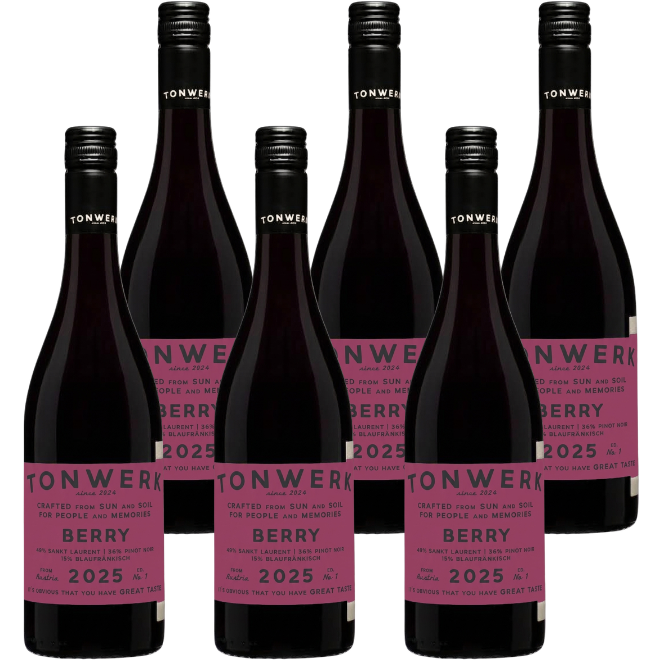
Light and juicy The Berry 2025 from Tonwerk in Burgenland is a light red wine made from 49% St. Laurent, 36% Pinot Noir and 15% Blaufränkisch. At 10.5% alcohol it is light and juicy, with red berries and cherry. Serve it well chilled, at 6 to 8 degrees.
Fruity and velvety The St. Laurent Rotwein Trocken from Weingut Dopler in the Thermenregion is a classic St. Laurent, aged in small wooden barrels. It is velvety, with red berries, cherries and a hint of spice, and received 90 points in the Falstaff Red Wine Guide 2024. The organic St. Laurent Ried Prädium 2022 from Weingut Habersack grows on stony gravel soil in Burgenland. You taste sour cherries and ripe morello cherries, with velvety tannins and 12% alcohol.
Powerful and oak-aged The 'Ried Frauenfeld' St. Laurent Reserve from Weingut Dopler is aged for 24 months in small oak barrels. It is concentrated and silky, with dark fruit and ripe cherries. The organic St. Laurent Ried Ronald 2022 from Weingut Leo Aumann comes from an Erste Lage (first growth) vineyard near Pfaffstätten. The grapes are picked by hand and the wine is aged for 18 months in 500-litre French oak barrels. The Badener Berg 2022 , also from Leo Aumann, is a blend of 50% St. Laurent and 50% Merlot from a vineyard at 300 metres. It is aged for 30 months in new French oak and only made in the best years.
St. Laurent in blends and as rosé St. Laurent also goes into red blends, such as the 'RUBiN' Rot Cuvée 2021 from Weingut Habersack, with Blaufränkisch and Zweigelt, and the 'Lindbergh' Cuvée 2017 from Weingut Dopler, with Pinot Noir. St. Laurent also makes fresh rosé. The St. Laurent Rosé BIO from Weingut Valentin Oppenauer is dry and fruity, with strawberry. The Valentastico Rosé BIO is off-dry and lightly sparkling.
Which one suits you? You like light and juicy. Choose the Berry.
You are looking for a classic, velvety St. Laurent. Choose the St. Laurent Rotwein Trocken or the Ried Prädium.
You want powerful and oak-aged. Choose the Ried Frauenfeld Reserve or the Ried Ronald.
You want something special for an occasion. Choose the Badener Berg.
You want a fresh rosé. Choose the St. Laurent Rosé BIO.
Where does St. Laurent grow? The main areas for St. Laurent are the Thermenregion, just south of Vienna, and the area around Lake Neusiedl in Burgenland. Austria's largest continuous area of St. Laurent lies near Tattendorf in the Thermenregion. Outside Austria the grape is grown in countries including Germany and the Czech Republic.
Thermenregion. Weingut Dopler in Tattendorf and Weingut Leo Aumann in Traiskirchen make St. Laurent on sandy and loam soils.
Burgenland. Weingut Habersack in Weiden am See makes St. Laurent close to Lake Neusiedl, and Tonwerk in Deutschkreutz uses it in the Berry.
Weinviertel. Weingut Valentin Oppenauer makes organic rosé from St. Laurent.
What food goes with St. Laurent? St. Laurent goes well with duck, game birds, pork tenderloin and mushroom dishes. Light, fruity wines are good with charcuterie, pasta and mild cheese. Powerful, oak-aged wines such as the Ried Frauenfeld Reserve go with game, braised red meat and mature cheese.
Buy St. Laurent at ONWINE At ONWINE you buy wine directly from the winemaker, and on our winemakers page you can read who is behind each wine. Shipping is free from 12 bottles from the same winemaker. Want to taste St. Laurent alongside other Austrian grapes first? The Austria Red Tasting Case includes the St. Laurent Ried Prädium. Looking for something else? Have a look at Zweigelt , Austria's best-known red grape, or Pinot Noir . More red wine is on our Austrian red wine page.
View Austrian red wine →
Frequently asked questions about St. Laurent Is St. Laurent related to Pinot Noir? That is often said, and they are similar in taste. One synonym of the grape is even Pinot St. Laurent. That the two grapes are related, however, has not been proven.
What is the difference between St. Laurent and Zweigelt? Zweigelt was bred in 1922 from St. Laurent and Blaufränkisch. Zweigelt is usually smoother and fruitier, St. Laurent more elegant and refined, with softer tannins. Want to taste them side by side? Take a look at our Zweigelt .
Is St. Laurent a light or a full-bodied wine? St. Laurent is usually light to medium-bodied, with soft tannins. Wines without long oak ageing, such as the Berry and the St. Laurent Rotwein Trocken, are lighter. Single-vineyard wines with long ageing in oak, such as the Ried Frauenfeld Reserve and the Ried Ronald, are fuller.
How long can you keep St. Laurent? A fruity St. Laurent is best drunk within three to five years. Wines with long oak ageing can often keep for eight years or more and become more complex with age. Store the bottles lying down, in a cool, dark place.